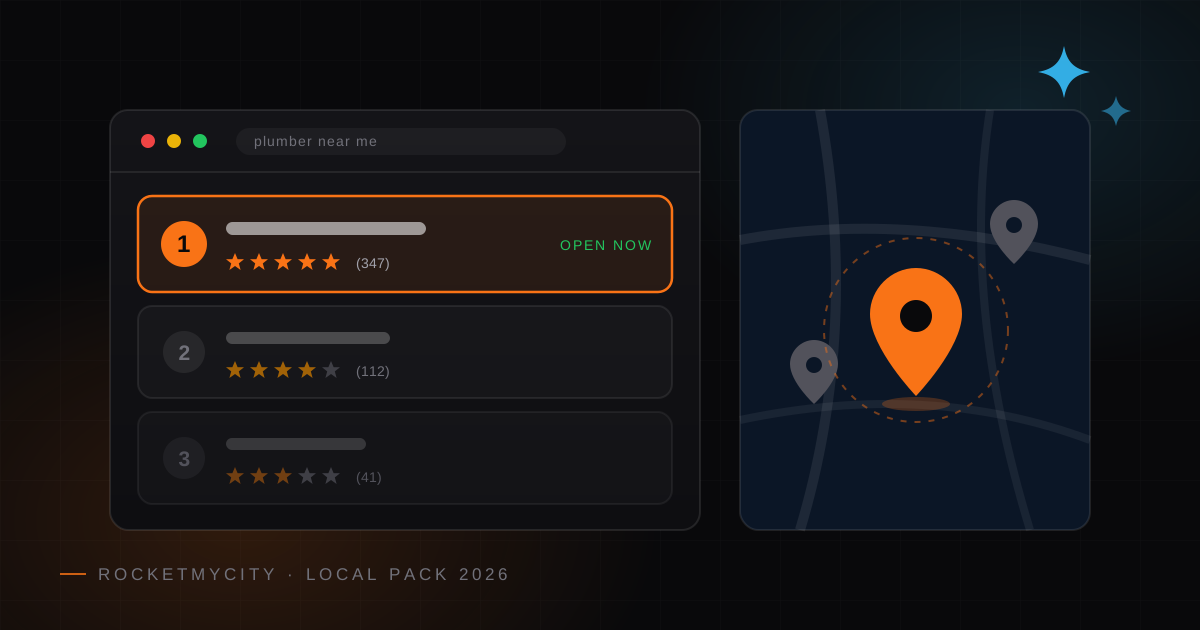
The local pack — the map with three business listings that appears for "plumber near me" and every search like it — is still where most home-service jobs are decided. But the page around it has changed, buyer behavior has changed, and a lot of the advice owners were sold in 2022 quietly stopped working. Here's what actually drives pack rankings in 2026, and what deserves your next 90 days.
What changed around the pack
The pack itself looks familiar. Its context doesn't. AI Overviews and answer-style results now sit on many local searches, summarizing "who to call and why" before a homeowner ever scrolls to the classic listings. Fewer clicks reach websites at all; more of the decision happens directly on the search page and inside your Google Business Profile. For a local trades company, the practical implication is blunt:
The good news: the fundamentals Google has always described — relevance, distance, and prominence — still explain most of what you see in the pack. What's changed is how each is weighted and measured.
Relevance: Google can only rank what you clearly are
Relevance is about whether Google understands what you do. In 2026 that understanding is built from a few concrete places:
- Primary category. Still the single highest-leverage field on your profile. "HVAC contractor" vs. "Air conditioning repair service" changes which searches you can even compete for.
- Secondary categories and the services list. Fill them out completely and honestly. An empty services section is a relevance leak.
- Service pages on your website. One genuinely useful page per service line — water heaters, drain cleaning, panel upgrades, storm repair — consistently outperforms one generic "services" page. These pages also feed AI answers.
- Consistency. Name, categories, services, and site content telling the same story. Mixed signals dilute all of them.
Distance: the ranking factor you can't fake (but can outgrow)
Proximity remains the strongest force in the pack, which is why your rankings differ street by street. You can't change where your shop sits, but you can stop pretending distance doesn't exist:
- Measure with a geo-grid, not a single search. Your real market position is a map, not a number. Checking rankings from the office tells you almost nothing.
- Build legitimate coverage signals. Service-area pages with real substance (jobs done there, local specifics, honest coverage claims) help you compete farther from the shop.
- Let reviews carry geography. Reviews that naturally mention neighborhoods and towns ("fixed our AC in Westside the same day") reinforce that you genuinely serve those areas. Never script them — just ask happy customers where it makes sense.
Prominence: reviews are the engine, but not only the star count
Prominence is Google's confidence that you're a real, trusted, active business. In practice, for the trades, it's mostly earned in four places:
- Review velocity and recency. A steady stream of recent reviews beats a big stale total. Ten reviews a month for a year outperforms 300 reviews that ended in 2024.
- Owner responses. Reply to everything, especially the bad ones. Responses are read by homeowners and processed as engagement signals.
- Review content. Reviews that mention specific services ("replaced our water heater") strengthen relevance for those services. This happens naturally when you ask for reviews right after the job.
- Real-world footprint. Mentions from local news, suppliers, chambers, sponsorships, and neighborhood groups. These same citations are disproportionately what AI systems lean on when deciding who to recommend.
Fresh photos and regular profile activity round this out — not because a Tuesday post ranks you higher by itself, but because active profiles convert better, and conversion behavior feeds the next factor.
The quiet fourth factor: engagement
Google watches what searchers do with your listing: calls tapped, directions requested, photos viewed, website clicks, bookings started. Listings that consistently win the click tend to keep winning. This is why "ranking" and "converting" have merged into one discipline — a compelling profile (strong recent reviews, real photos, accurate hours, services listed, questions answered) both persuades homeowners and reinforces your position.
What stopped working (and now backfires)
- Keyword-stuffed business names. "Smith Plumbing – Emergency Plumber Water Heater Repair" is a suspension risk, and profile suspensions in 2026 are slow, painful appeals.
- Citation blasts. Submitting your business to 400 junk directories does nothing. A consistent core of real citations is table stakes; volume is not a strategy.
- Review gating and bought reviews. Detection got materially better. A wiped review profile is worse than a slow one.
- Fake engagement. Clicking your own listing from the shop Wi-Fi has never been a plan.
A 90-day priority list for owners
- Weeks 1–2: Audit your profile. Correct primary category, add secondary categories, complete the services list, fix hours (including after-hours availability), and load 20+ real job photos.
- Weeks 2–4: Run a geo-grid scan for your top three revenue keywords. Identify where you're green, yellow, and invisible. This is your baseline — you can't manage what you haven't mapped.
- Weeks 3–8: Build or rewrite one service page per major service line, plus service-area pages for your two most valuable weak zones from the scan.
- Weeks 3–12: Install a review system: ask on job completion, every job, with a direct link. Target steady weekly velocity, and respond to every review within 48 hours.
- Week 12: Re-run the geo-grid. Compare maps, not vanity rankings. Movement in the neighborhoods you targeted is the only score that matters.
The needle-mover most companies skip
None of the above is exotic. That's the point — in 2026 the local pack rewards businesses that look, to both Google and AI systems, like the obvious safe choice in a specific place for a specific job. The companies losing ground aren't doing the wrong things; they're doing unmeasured things. Map your market first, fix the highest-revenue gaps, and let the compounding work for you instead of your competitor.